

Power Supplies
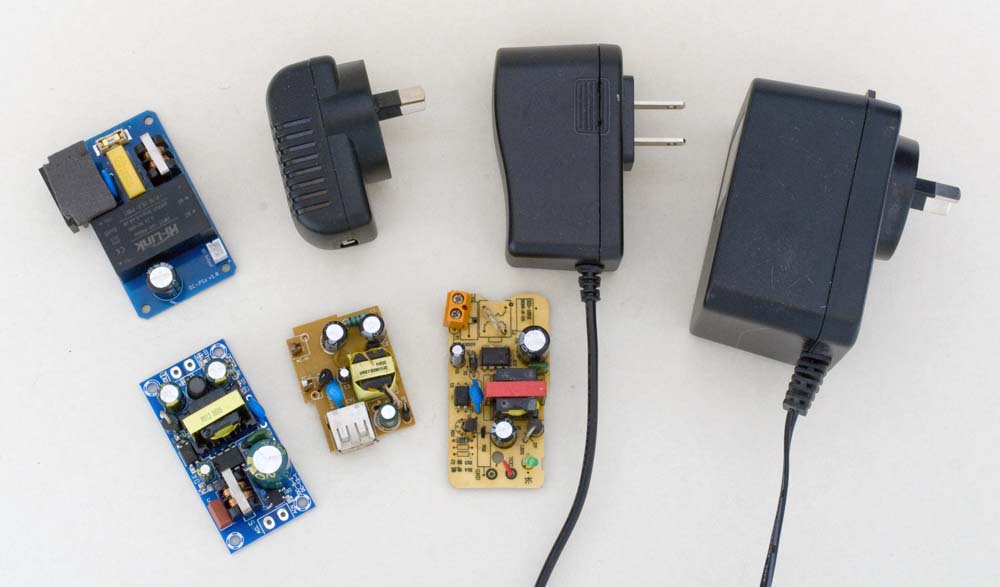
In most applications that do not rely primarily on battery power, I have used an external 5V source through either a USB or conventional barrel jack connector. Where the application is monitoring or controlling some external power source, however, it seemed logical to also use that source to power the relevant monitoring device. In this case, and given that, in Australia, domestic power is supplied as 230V AC, the requirement then becomes one of converting 230V AC to 5V or 3.3V DC.
There appeared to be two obvious options, one being to simply purchase an appropriate off-the-shelf power supply, the other to design one ourselves. Without having an electrical engineering background, I really had no idea what was involved is designing a power supply from scratch, except that 230V AC should go in one end and 5V (or maybe 3.3V) DC should come out the other. That pretty much left me exploring off-the-shelf alternatives.
I had noticed that AC/DC power adaptor plug packs (like the black items illustrated above) came in many shapes and sizes and that there was no real correlation between the size of a device and its output voltage. I also knew from my limited physics background that one could convert an AC voltage to a DC voltage using a bridge rectifier, but there was obviously a lot more going on with even the simplest plug pack. To manage my lack of knowledge in this department, my earlier efforts simply involved pulling apart a couple of the smaller plug packs and reconfiguring the internals (the beige coloured circuit boards in the above photo) within my application enclosure.
This worked OK when the power supply board so acquired could be snugly housed within the relevant enclosure, but when it came to powering the Power Switch Node, these boards lacked usable mounting points. My choices to this point had been driven primarily by cost, with a small plug pack costing less than A$5 while the 'stand alone' power supplies that I'd seen up to that point were all much larger and more costly.
It turned out that I just hadn't been looking in the right place, and, for much the same price, I ultimately found several options that included appropriate mounting holes. One of them, at left below, was even perfectly sized to fit on the intended [13095-BPHC] processor board, at right below.
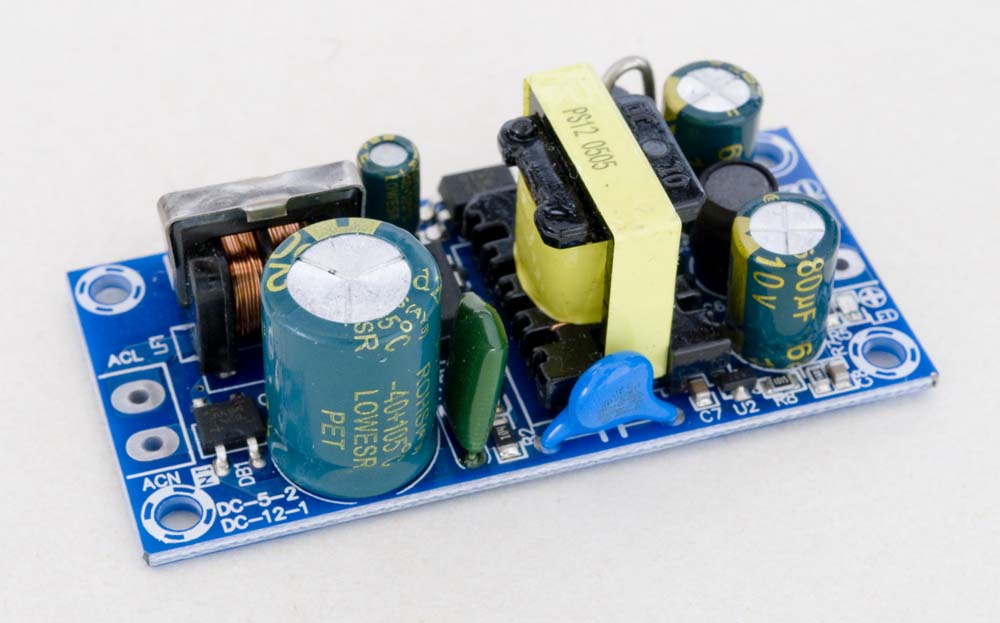
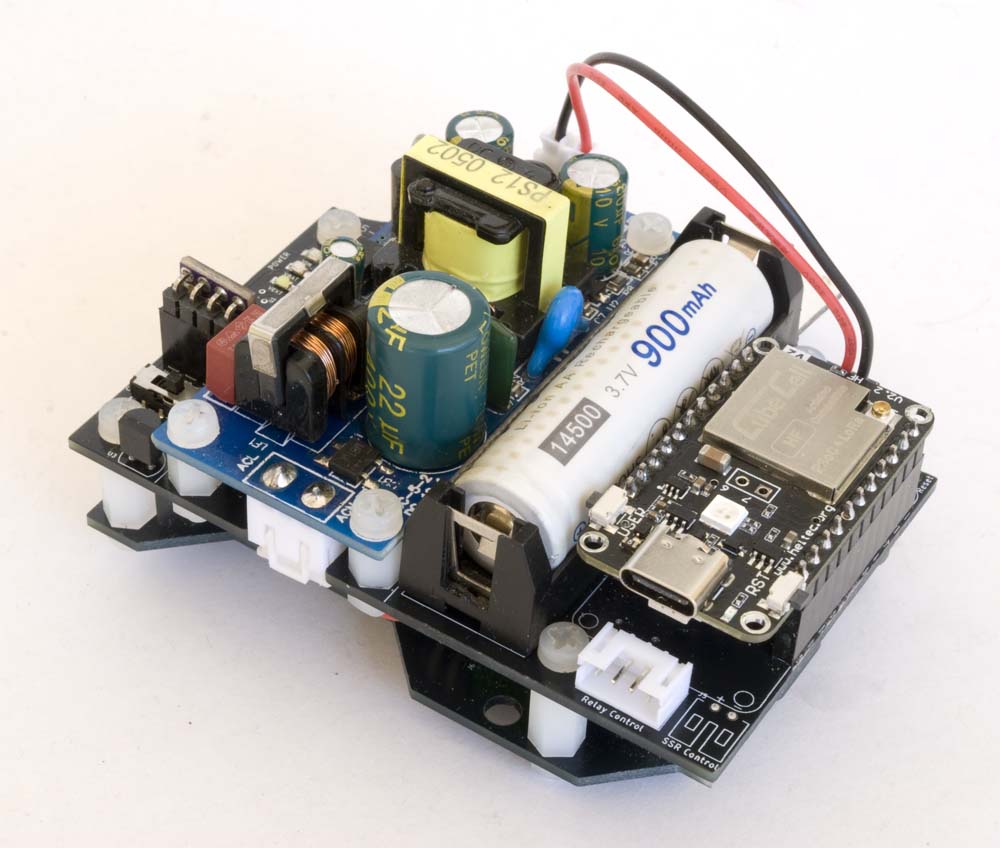
An added benefit of using this particular power supply module was that it was just one of several, with output voltages ranging from 3.3V to 12V, on the same form factor, making them interchangeable as an application might demand.
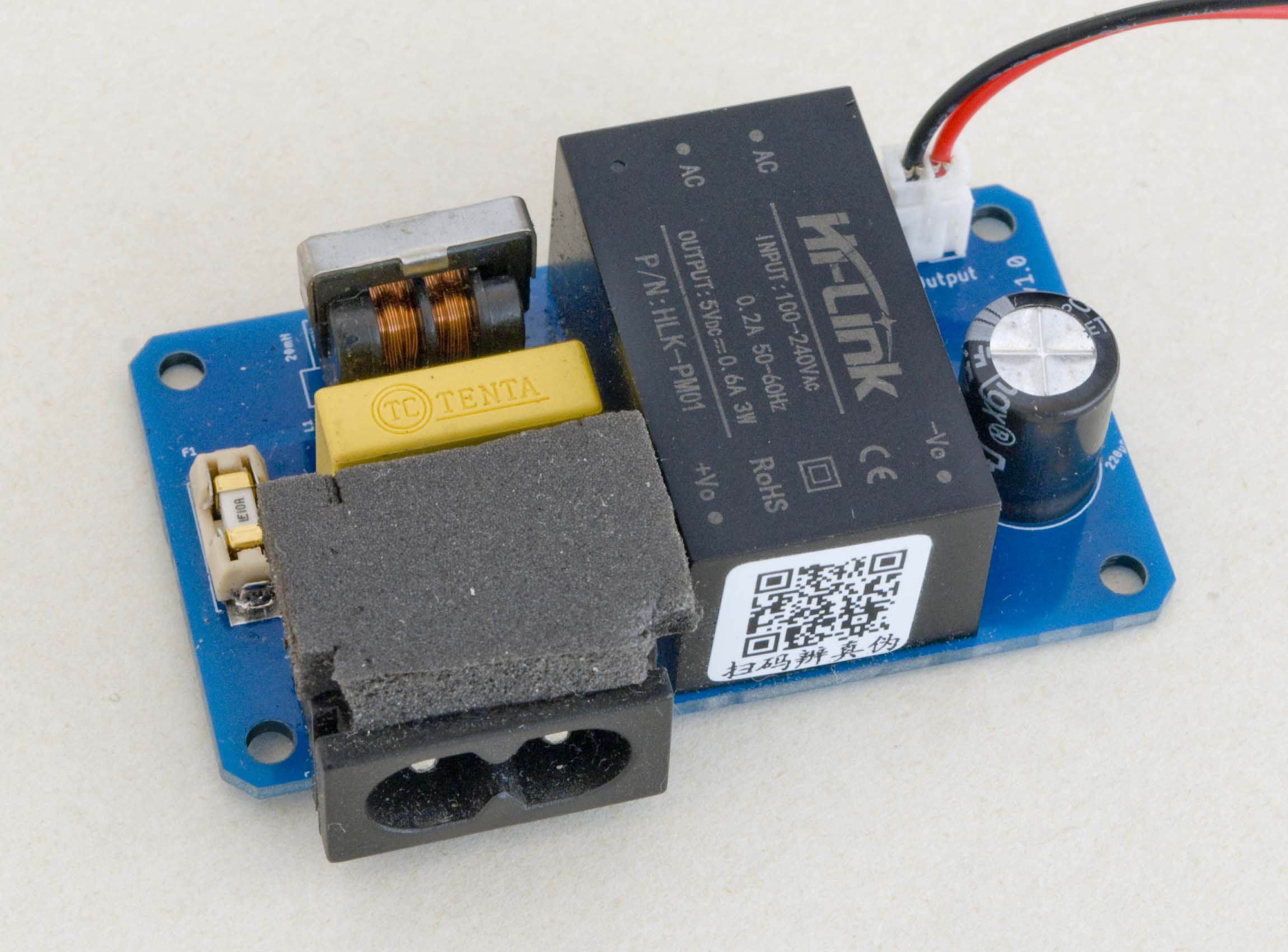
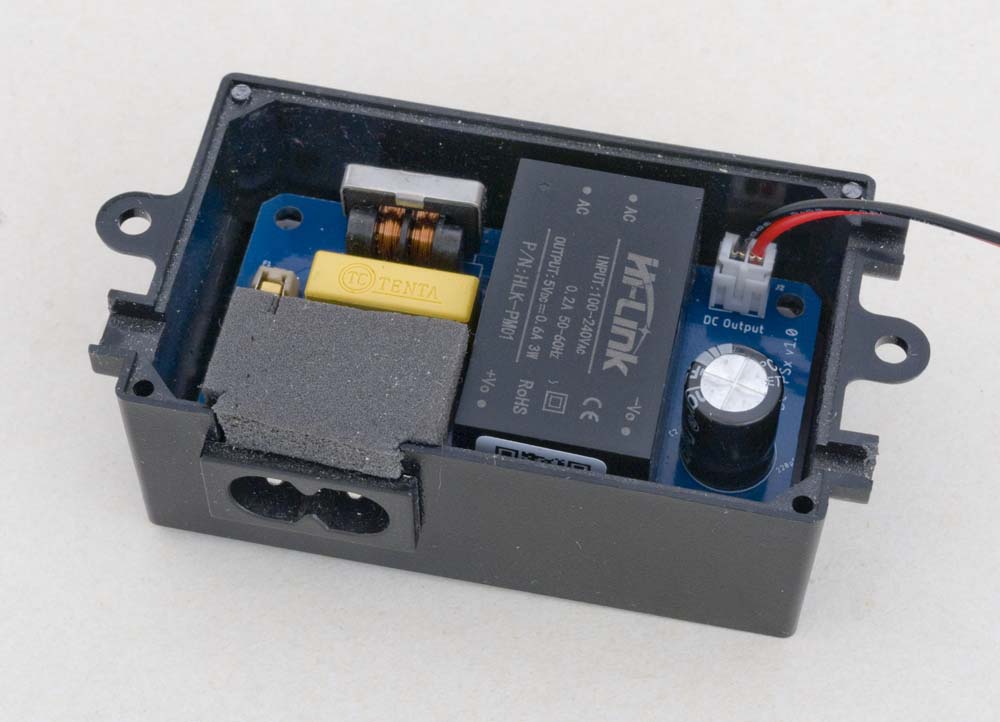
Some time later, and with a little understanding of what was required to build a power supply, I discovered the range of Hi-Link power supply modules and thought they might offer a more compact solution. This led to the DC‑PSx power supply PCB, designed, for prototyping purposes at least, to fit inside another readily available [72 × 44 × 27] project enclosure. Simply because space allowed for it, this board also includes two input and output options—screw down connectors for each, as well as an IEC AC input socket and a JST PH2.0 DC output socket, the latter illustrated in the photos below. Unfortunately, the Hi-Link modules only provide part of a complete power supply solution. While there is some flexibility provided though control of the layout of all of the necessary components, the overall size of a complete solution was much the same as that of the item I had originally sourced and it was only marginally cheaper. As a result, for the time being, this custom power supply has been consigned to my box of 'educational exercises'.
To be continued...