

7-in-1 Soil Condition Sensor
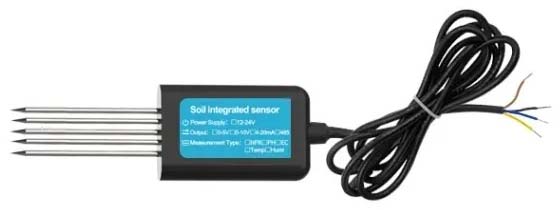
Some commentary on the subject would seem to suggest that the validity, or at least accuracy, of measurements made with this type of sensor are questionable. The exercise here is nonetheless more one of establishing the requirements for communications with an RS485 sensor than anything to do with the sensor itself or the measurements it reports.
To date, I have used the manual for a similar sensor, retrieved from the ComWinTop website, as a guide in forumlating the necessary Modbus RTU queries.
Testing Notes
- The sensor specifications indicate that it will operate with a supply voltage of 4.5~30V. In the event, it responded to Modbus RTU queries reliably and reported plausible ambient temperature readings—other readings are a bit meaningless in a 'bench testing' environment—on a 5V supply from the [USB powered] CubeCell Plus.
- Supplied with a default baud rate setting of 4800 but could be reset to 9600 using the relevant Modbus RTU command.
- Responds to a Modbus RTU broadcast address of
0xFF(0x00is not recognised as a valid address—i.e. queries to that address do not elicit any response). - As supplied, when queried this sensor reports a Slave ID of
1. It also accepted a query to change this [to a Slave ID of2] and subsequent queries reflected this change. It will respond to queries directed either to its current Slave ID or the broadcast address. Note that this, what I would consider the expected or correct behaviour, contrasts with the behaviour of the other RS485 sensors I have tested.
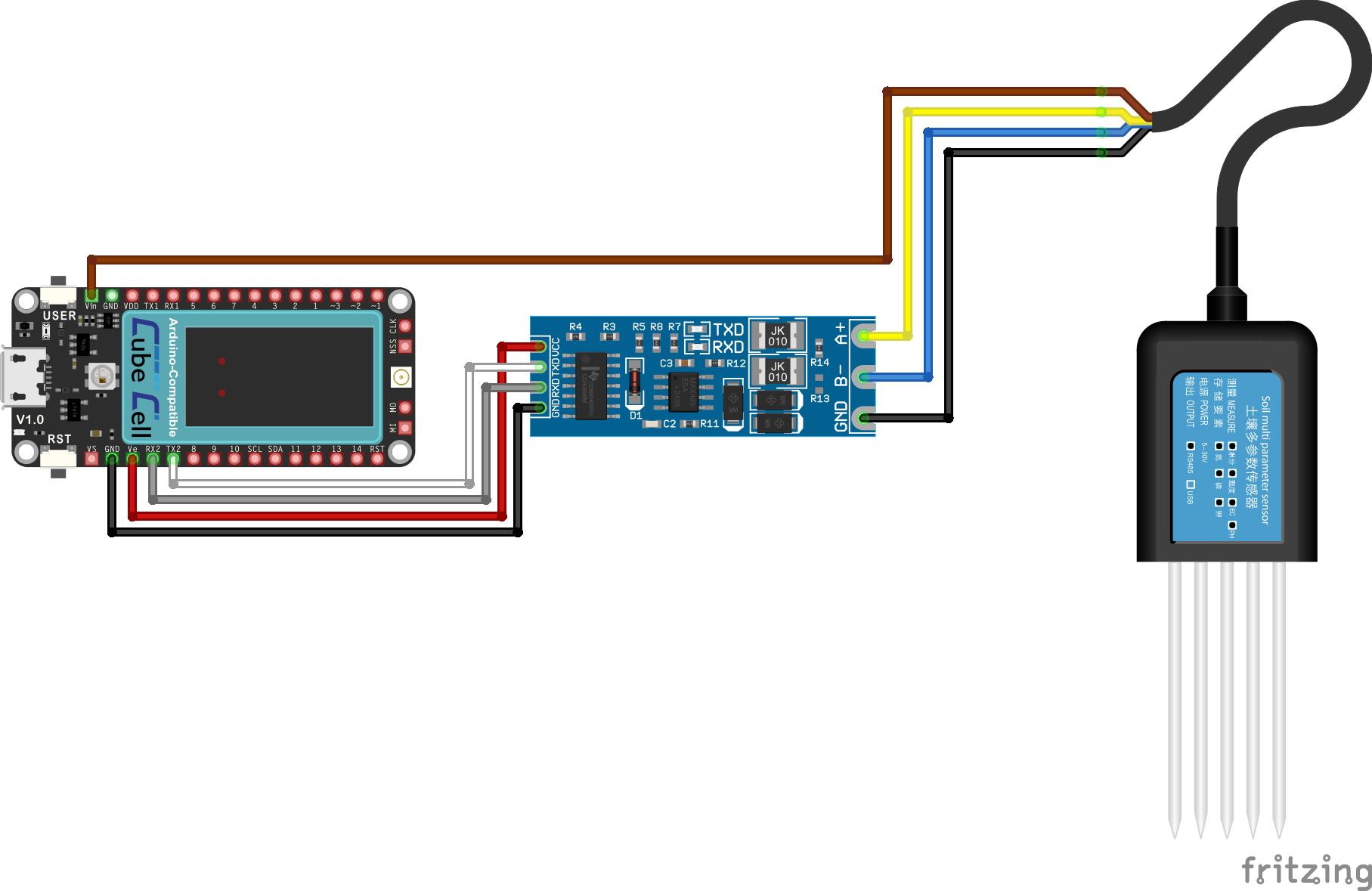
7-in-1 Soil Condition Sensor [RS485] Configuration Circuit
Pin Configuration
| CubeCell Plus | UART-to-RS485 | 7-in-1 Probe |
|---|---|---|
| GND | GND | |
| UART_TX2 | Tx | |
| UART_RX2 | Rx | |
| Vext | Vcc | |
| Vin | Brown | |
| A+ | Yellow | |
| B- | Blue | |
| Sig-GND | Black |
Note that the colours of the RS485 wires on various probes that I have tested have all been different so it is important to verify which wire is which on any given probe and not rely on any idea of standardised colouring of wires.
Software
Use the following as the basis for an interactive sketch that allows the user to select the command to send and then reports the result.
|
Further details pending